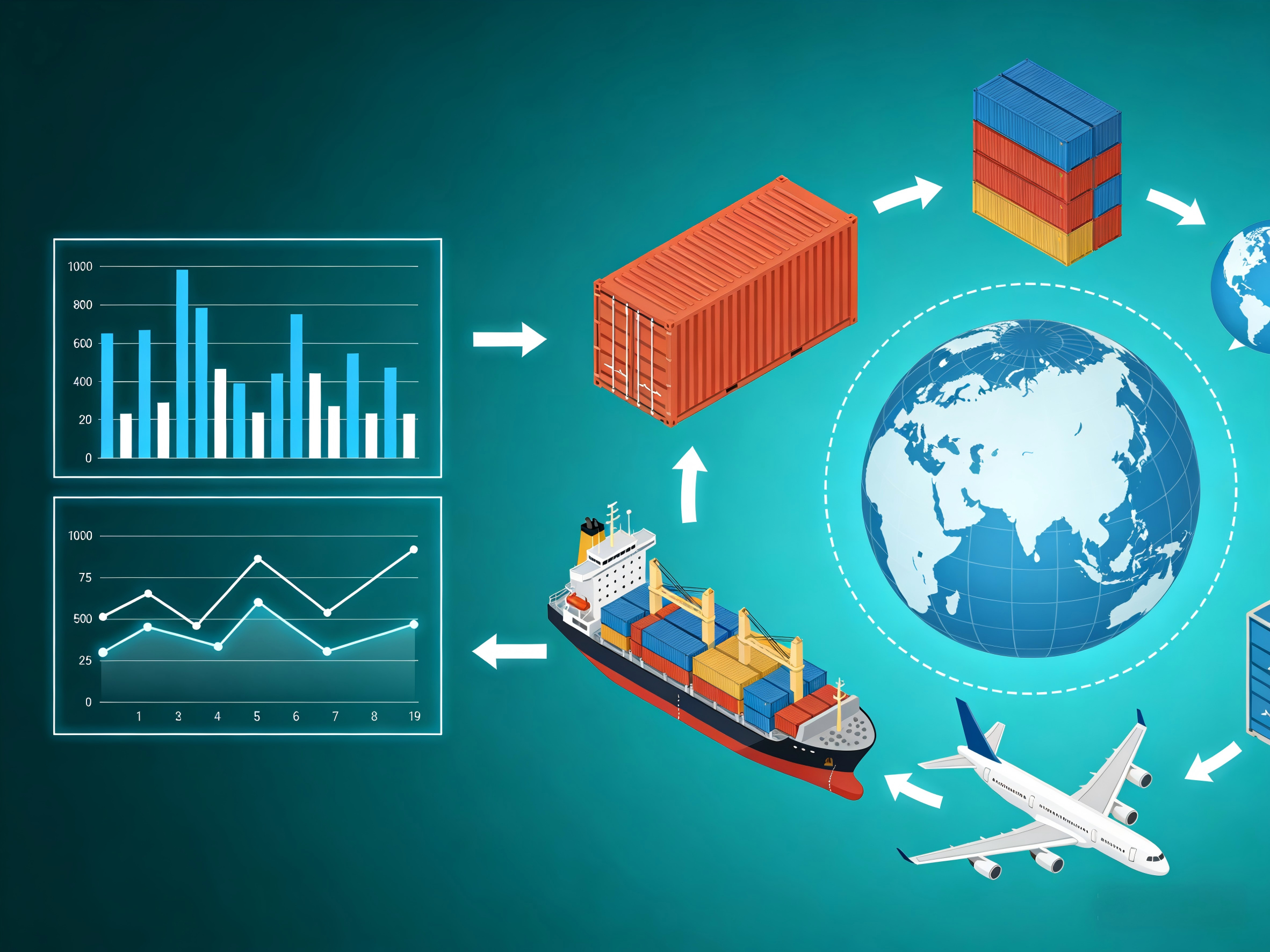
Veterans in foreign trade know that today’s global trade environment is no longer an era where you can rely solely on exhibitions and yellow pages to succeed. With the restructuring of global supply chains and the upgrading of trade rules, foreign trade companies are facing increasing challenges. Difficulties in finding customers, high risks, and tough decision-making have become core pain points across the industry.
i. difficulty in finding customers
Many data providers on the market offer buyer information that is either more than three months outdated or pieced together from invalid data. Companies spend tens of thousands on annual subscriptions only to find that more than half of the leads are from businesses that have closed down or no longer purchase. Precise targeting is impossible, let alone conversion.
ii. high risks
Foreign trade involves cross-border logistics and foreign exchange settlements. If a supplier or buyer has a bad transaction record, the consequences can range from delayed deliveries missing sales windows to total loss of capital. However, many companies have no access to such core background information and can only rely on luck when cooperating.
iii.difficult decision-making
When expanding into new markets, companies lack insight into import/export volume and price trends of target countries. When optimizing products, they do not know the global layout of competitors or customer preferences. Decisions are often based on intuition, easily falling into the trap of market mismatch and wasting upfront investments.
1. Cross Border Search’s 15 Years of Deep Industry Experience
Founded in Shanghai in 2009, Cross Border Search has been deeply engaged in the foreign trade data field for 15 years. It is a veteran player in the industry, having witnessed the entire transformation of foreign trade from traditional offline methods to digitalization.

Starting with trade data from only 18 countries, it expanded to 21 countries in 2012. In 2014, it established a Nanjing office, and in 2015, it expanded into South China’s Dongguan. Cross Border Search’s business footprint has gradually extended from East China to the whole country, now with branch offices in several core foreign trade cities. The team size reaches 500–999 people, with a registered capital of 9.9 million RMB.
In 2016, it launched the industry’s first mobile APP, allowing companies to check trade updates anytime without being tied to a computer. In 2017, it introduced the “One-Click Search” trade keyword search engine, simplifying data search operations. In 2018, it launched Vemail, a high-precision email tool, solving the problem of finding customer email addresses. In 2021, active users exceeded 10,000+. In 2022, it initiated online exhibitions covering Belt and Road countries, keeping pace with the digital transformation of foreign trade.
After 15 years of accumulation, Cross Border Search has served over 50,000 clients, built extensive industry experience and success stories, and can quickly respond to market changes to meet the application scenarios of different foreign trade companies.
2. Global Authoritative Data Resource System
Cross Border Search’s core competitiveness first lies in its vast and authoritative data resource pool – something many smaller providers cannot match. After all, the authenticity and coverage of data directly determine business outcomes for foreign trade companies.
It has built a corporate data network covering over 200 countries and regions, integrating 260 million active global business profiles, over 10 billion real transaction records, and more than 50 million buyer resources across over 260 sub-sectors. It also consolidates logistics and customs data from over 600 major global ports, enabling companies to fully understand global trade dynamics.
To ensure data authority, Cross Border Search has established deep partnerships with over 50 European and American chambers of commerce, over 80 internationally renowned chambers, and more than 200 industry associations and trade organizations. All data comes from officially authorized channels, not randomly scraped wild data, avoiding trade risks caused by false information.
Beyond trade data, Cross Border Search also holds over 1.18 billion business relationships and more than 850 million corporate contact profiles, including over 990 million contact emails and over 860 million contact social media profiles. This provides multi-touchpoint communication channels, avoiding the limitations of relying solely on email and increasing success rates.
More importantly, Cross Border Search’s data is updated daily, ensuring timeliness. Companies can access the latest transaction dynamics of target markets in a timely manner, avoiding missed opportunities due to outdated data.
3. Proprietary Core Technology Advantages
Data alone is not enough – the ability to use data well depends on technological strength. Cross Border Search has invested heavily in R&D of core technologies, building its own technological moat.
i. First is virtualization technology.
By integrating virtualization technology, it has created a cloud-based “mini-supercomputer” that aggregates the computing, storage, and internal gigabit transmission capabilities of N physical servers with near-zero loss. This enables faster processing of massive data and stronger stability. Compared to providers using ordinary servers, efficiency improves by more than 30% when processing similar data volumes, saving waiting time for companies.
ii. Next is the AI data model.
Leveraging decades of technical, data, and experience accumulation, Cross Border Search has developed a repeatedly validated effective AI model that enables intelligent data analysis – for example, automatically identifying abnormal trade data and filtering out false or invalid transaction records, so companies receive precise, useful information without spending time on screening.
In terms of databases, Cross Border Search employs a distributed architecture using six mainstream database types, combining the high concurrency of NoSQL, the high stability of relational databases, the unstructured storage of document databases, the massive data processing capability of time-series databases, and the analytical processing power of big data platforms. This perfectly adapts to different types of data storage and analysis needs – whether querying a single transaction record or conducting industry trend analysis, the system responds quickly.
There is also a proprietary search and analytics engine with over 120 independent data compute nodes, built-in cross-lingual word segmentation, semantics, relevance, and other core intelligent capabilities. When companies search, they can quickly and precisely locate target customers and market data without sifting through vast amounts of information, saving significant time.
Data collection and processing are also robust. Nearly 100 data resources are officially authorized from global customs authorities, updated daily. Based on a big data processing platform and decades of experience, the cleaning process organizes messy data into standardized, usable information. AI trade profiling technology further identifies abnormal trade data, enhancing data quality.
4. Full-Link Foreign Trade Service Function Matrix
Cross Border Search is not just about data; it has built a full-link service system from market insight to deal closing, meeting various needs of foreign trade companies without the need to patch together functions from multiple providers.
For example, the industry-first Corporate Graph function integrates global trade data, corporate relationships, supply chain structures, and import/export flows, presenting key dimensions such as suppliers, buyers, export destinations, countries of origin, main product structures, and transaction shares in a visual graph. Companies can see at a glance a target customer’s real purchasing capability and supply chain stability, analyze competitors’ market strategies, and develop more precise outreach plans.
i. The “Foreign Trade Email” function is also a highlight.
It holds billions of valid global corporate emails with high deliverability. It allows online precision searching of corporate personnel emails and, paired with a leading EDM platform, enables one-click bulk sending and tracking, efficiently developing new customers. It also integrates deeply with “Souyu” and Qixin CRM, achieving seamless connection from data insights to customer outreach without switching between systems.
The “Souyu” function serves as an intelligent customer acquisition portal, offering multiple channels such as global company search, AI engine search, exhibition lead generation, map-based lead generation, and tender information. It covers customer development across different scenarios and includes intelligent email sending, marketing promotion, data analysis, and smart customer management, improving business efficiency and conversion rates.
Additionally, Cross Border Search has launched the “Qixin AI+” tool, the first AI tool in the trade field, covering buyer development, data analysis, market insight, and other needs. It can also generate product images, model images, detail images, posters, etc., with one click, meeting full-link visual needs and helping brands spread efficiently on social media, reducing design costs for companies.
The Qixin CRM system enables business closure, digitally managing the entire process from lead management to customer follow-up and transaction conversion, making customer management more standardized and efficient, avoiding information omissions due to manual records.
5. 7×24 Full-Cycle After-Sales Support
Foreign trade operations run around the clock. When problems arise in the middle of the night, after-sales response speed is critical. Cross Border Search excels here, having built a full-cycle after-sales support system.
It provides 7×24 on-call service. No matter when an issue occurs, companies receive efficient responses, avoiding business delays due to slow support. For example, if companies encounter data query problems or system operation failures at night, they can quickly reach support personnel.
For complex issues, Cross Border Search offers 1-on-1 exclusive interpretation and provides quarterly proactive optimization suggestions to help companies better use data and tools, improving operational efficiency. For example, based on a company’s products and markets, it may suggest which countries’ buyers to focus on and which data dimensions can improve lead generation accuracy.
Additionally, it provides software system training and on-demand, irregular after-sales assistance. Training content is available as videos for review, making it easy for employees to learn repeatedly, ensuring new hires can quickly get up to speed even after employee turnover.
Cross Border Search also regularly shares industry news and recommends exhibition markets semi-annually or quarterly, helping companies identify opportunities and explore potential markets. It even offers long-term sample display services with no outbound risks, supporting online and offline overseas marketing, solving the problems of high costs and risks associated with sending samples abroad.
Fund security is also guaranteed, with 1-on-1 online Q&A and accompanying order tracking, so companies don’t worry about financial issues during the service process – everything is transparent and controllable.
6. Tailored Pre-Sales Service Details
Many foreign trade companies have different needs. Some are manufacturing exporters, others are trading companies. Cross Border Search’s pre-sales service precisely matches these needs, avoiding a one-size-fits-all approach.
First is needs analysis and solution customization. The professional team communicates deeply with clients in advance, fully understanding product, market, budget, and other information, then tailors an exclusive solution. Multiple options are offered for clients to choose from. For example, for manufacturing exporters, the focus is on buyer data and market trend analysis; for trading companies, the focus is on bill-of-lading data and supply chain analysis.
Then comes product demonstration and trial, available online or offline, allowing clients to experience the product’s functions and operation process, intuitively feeling its effectiveness and avoiding blind purchases. For instance, clients can try the visual analysis of the Corporate Graph or use the Souyu tool to search for buyers in a target market, checking the accuracy and coverage of data.
Notably, Cross Border Search also provides clients with a free buyer list. For companies new to foreign trade or looking to expand into new markets, this is equivalent to first-hand precise leads, allowing them to quickly enter the market and save the time and cost of early customer discovery.
7. Practical Value of Digital Transformation in Foreign Trade
For foreign trade companies, choosing Cross Border Search’s services is not just buying a set of data tools; it is embracing digital transformation, enhancing core competitiveness, and solving real business pain points.
For example, a manufacturing export company previously relied on traditional exhibitions to find customers, spending hundreds of thousands annually with high acquisition costs and low conversion rates. After using Cross Border Search’s services, through Corporate Graph analysis of buyer structures in target markets and precision customer development with Souyu, its customer acquisition cost dropped by 40% within half a year, and conversion rates increased by 25%, directly boosting profitability.
Another import/export trading company previously suffered a loss of over 100,000 RMB due to a supplier delaying delivery because it had no knowledge of the supplier’s historical transaction records. After using Cross Border Search’s bill-of-lading data to screen for risks, it identified suppliers with bad records in advance and avoided subsequent trade risks, saving over a million RMB annually in potential losses.
These real cases demonstrate that Cross Border Search’s services can effectively help foreign trade companies solve practical problems, improve operational efficiency and success rates, and serve as a solid backing for companies navigating the global market.
Of course, when choosing a data service provider, foreign trade companies also need to verify the authenticity, timeliness, and coverage of the data, avoiding white-label providers without official authorization or slow data updates. Otherwise, they will not only waste money but also face trade risks – a loss far outweighing the gain.